

A Leaving Cert AI tutor may offer free access, but fuller support can require a subscription. The cost and what you can use vary between tools, so check whether the help you need is included.
It makes sense to look for an affordable way to practise. A tool is useful when it supports your Irish syllabus, explains answers clearly and offers practice that matches the kind of work you need to do.
This guide compares AI tutors with grinds, textbooks and other AI apps. You’ll learn how to assess syllabus coverage and past-paper support, and how to choose help that guides you through questions rather than simply giving you answers.
Key Takeaways
- Free access can differ between AI tools. Compare what each option includes before building it into your study routine.
- Look for Irish syllabus support and exam-style explanations, not just quick answers to general questions.
- Choose support to suit your level and subject, then use it to practise working through questions step by step.
- Check how past-paper practice is organised, so you can focus revision on the topics you need to strengthen.
AI platforms tailored to the Irish Leaving Cert
A Leaving Cert AI tutor should match the Irish syllabus, not just explain topics in general terms. For example, ask it to break down a Biology concept, then request a short exam-style response. Check that the explanation includes relevant marking points and clear English, rather than broad advice that could apply to any course.
To prepare for exams, use a simple practice loop: choose a topic, attempt a question, then ask for a hint or feedback on your reasoning. After a Maths problem, for example, ask which step needs attention before requesting a full explanation. This keeps you actively involved and helps you spot gaps.
Schools and the State Examinations Commission may set rules for coursework. SEC 2026 guidelines prohibit submitting AI-generated material as a student’s own coursework. Use AI to practise, clarify ideas and review your own work, not to produce coursework for submission.
Privacy matters too. The Department of Education says information entered into generative AI systems may be used to train the model or shared with a third party. Avoid entering names, school details, personal circumstances or identifiable coursework. Use a made-up example when you need help understanding a question.
Can an AI tutor help with Irish? It can support your study if the platform can understand and answer in the language. Try a short prompt about a topic, then ask for a simpler explanation or feedback on your Irish response. Check that the wording suits the task rather than relying on an answer just because it sounds fluent.
Before using a platform regularly, test it with a syllabus topic and an exam-style question. Notice whether it gives useful hints, explains why an answer works and responds well to follow-up questions. A helpful conversation should make your next study step clearer. Treat its answer as learning support, not a replacement for your own judgement or class materials.
Comparison with grinds, textbooks and other AI apps
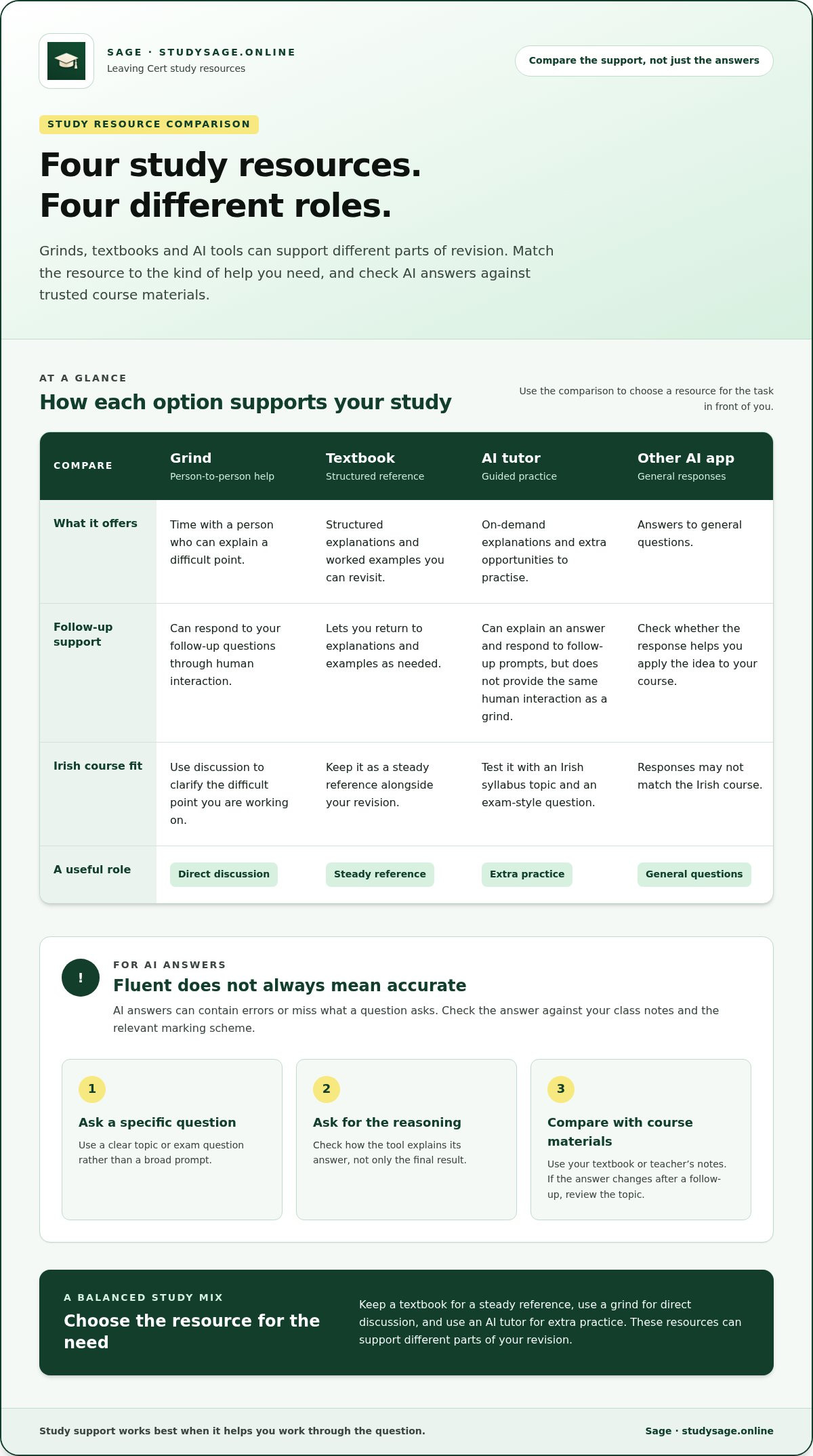
Each option supports a different part of studying. Compare the explanations, feedback and exam practice each provides.
Study resource comparisons
A grind gives students time with a person who can explain a difficult point and respond to follow-up questions. An AI tutor can offer on-demand explanations, but it cannot provide the same human interaction.
A textbook offers structured explanations and worked examples that students can revisit. Other AI apps may answer general questions, but their responses may not match the Irish course. Compare tools by testing one topic, such as a Shakespeare play in English, and checking whether the explanation follows the syllabus and helps you apply the idea.
Exam preparation accuracy
How accurate are AI tutors for Leaving Cert exam preparation? Their answers can be useful, but they can also contain errors or miss what a question asks. Compare an answer with your class notes and the relevant marking scheme. For example, check whether a Biology response includes the key points the question requires, not just broadly correct information.
Try a three-step accuracy check: give the tool a specific question, ask it to explain its reasoning, then compare that explanation with your textbook or teacher’s notes. If the answer changes after a follow-up prompt, treat that as a cue to review the topic. A fluent response does not prove that every detail is correct.
Use a mix of resources for different needs: a textbook for a steady reference, a grind for direct discussion, and an AI tutor for extra practice. Explore Irish curriculum AI study support when you want guided explanations alongside your revision.
Higher and Ordinary Level syllabus coverage
Higher and Ordinary Level can approach the same subject differently. A useful platform should make the level clear before explaining a concept. Try a topic you are studying and ask for an explanation suited to your chosen level. Then compare its detail and challenge with your class notes.
Coverage matters across subjects, too. A tool that handles Mathematics may not explain a History essay or an Irish grammar point equally well. Test each subject separately. For example, ask for a worked algebra step, then request a concise outline of an essay argument. Check whether each answer fits the task.
Use this quick check for each subject and level:
- Enter the topic and your level in the prompt.
- Ask for one example question at that level.
- Try the question before reading the answer.
- Compare the explanation with notes and relevant SEC marking schemes.
This check helps you see whether a response includes the points expected in an exam answer. A polished explanation can still leave out a required step or detail. In Chemistry, for instance, check whether a worked answer shows the reasoning, not just the final result.
For a difficult concept, ask for a smaller step rather than a simpler level. You might request a definition first, then a worked example, then a fresh practice question. This helps you find where your understanding breaks down without lowering the challenge unnecessarily.
Keep a short record for each subject. Note the topic, level, question and any gap you found. If an answer seems too advanced or too basic, restate the level and ask for a new example. This gives you a fairer test of syllabus fit than one broad prompt covering several topics.
Past-paper frequency and topic resources
A past paper helps you practise the actual exam format and shows how a topic can appear in different questions. Use papers alongside topic notes, not as a substitute for learning the subject. Getting the answer right matters, but so does showing the steps or explanation the question asks for.
Build a repeatable study cycle around each topic. First, revise the relevant concept. Next, try a question without notes. Then compare your response with the marking scheme. This shows whether you missed a key point, misunderstood the wording or need more practice. After revising a History topic, for example, attempt an essay question and check whether your answer addresses its instruction.
Topic-based practice is useful when a full paper feels too broad. Choose a question on the area you have just studied. Note the question type and the mistake you made, then return to the topic after reviewing the explanation. This turns a past paper into a guide for your next study session.
Full papers serve a different purpose: they help you practise moving between topics and managing a complete exam task. Try one after building confidence with individual questions. Afterwards, group errors by cause, such as missing knowledge, unclear working or misreading the question. That record helps you decide what to revise next.
Test how an AI tool handles past-paper prompts before relying on it. Ask it to explain a question, identify the points an answer needs, or create a similar practice question. Compare its explanation with the actual question and relevant marking scheme. If it interprets the question differently, use the paper and scheme as your reference.
Try guided, exam-style practice to work through questions one step at a time. Practise Leaving Cert exam-style questions and use each response to identify your next revision step.
StudySage: Monthly Subscription
StudySage offers a monthly subscription for students who want steady, Irish-curriculum study support. It covers 53 Junior Cycle and Leaving Cert subjects, including English, Irish, Mathematics, Science and History. Use it to practise questions, work through homework or ask about a topic that needs another explanation.
StudySage provides exam-style answers informed by SEC marking schemes. Its AI tutor guides students with one hint at a time, helping them think through a question rather than simply giving the answer. This can support independent revision between classes or extra practice in a subject that feels difficult.
If guided practice fits your study routine, visit StudySage online to learn more.
Build a study routine that works for you
Choose one subject that needs regular attention and make space for it in your weekly study plan. Keep the plan realistic: a short, focused session is easier to repeat than an ambitious schedule that quickly falls away. After each session, note what still feels unclear and use that to choose your next task.
A Leaving Cert AI tutor can become one part of your routine, alongside classwork and your own revision. A useful measure is whether it helps you return to a topic with a clearer next step. If your study needs change, adjust the routine too. Steady effort matters more than trying to cover everything at once.
If you’d like to explore guided support for your Leaving Cert studies, ask StudySage about Leaving Cert support. Take the next step at a pace that suits you, and keep building from what you learn.
Frequently Asked Questions
Are these tools free?
AI study tools vary in what they include and how they charge. Free access may be enough to try a question or test an explanation, while subscriptions can provide access to more features or subjects. Before relying on a tool for regular revision, try it with a difficult topic and see whether its answers help you make progress.
What’s the best AI tool for Leaving Cert study?
The best fit is a tool that supports your subjects and helps you understand the work, not just finish a task. Try the same question in a few tools and compare how clearly each explains its reasoning. Ask for a hint first, then see whether you can complete the next step yourself. Choose the tool that supports this kind of active study.
What AI tutors are available for Leaving Cert students in Ireland?
Irish students can use general-purpose AI apps or tools designed for secondary-school study. The difference often lies in how specifically a tool supports the Irish curriculum and exam preparation. Before settling on one, test a question from a current class topic and ask for a follow-up explanation. A tool that responds clearly to your actual question may suit your routine better than one that offers only broad summaries.
Which AI tutors cover Leaving Cert subjects and exam syllabuses?
Look for a tool that names the subjects and levels it supports, then test a topic you are studying. Ask it to explain a specific concept or create a practice prompt. Check whether its answer matches your class material and course terminology. This gives you a practical way to judge syllabus fit rather than relying on a broad claim of exam coverage.
What do Leaving Cert AI tutors cost in Ireland?
Costs depend on the tool’s payment model and which features it includes. Some offer free access; others use a recurring subscription. StudySage is available through a monthly subscription. Compare the access period and the study features you’ll use, such as subject help or practice questions, before deciding whether a paid option fits your study routine and budget.
Are there free AI tutoring tools suitable for Leaving Cert students?
Free tools can help with a focused task, such as asking for a plain-language explanation of a difficult term. Suitability depends on how well the answer fits your course and whether it helps you learn. Try a question from your notes, check the explanation against class material, and use a follow-up prompt to ask what you should try next.